


This guide covers how much virtual medical assistants earn, whether pay differs by country, which skills raise the rate, what affects take-home beyond the hourly rate, and how virtual medical assistants get paid.
This guide covers how each of those shifts the range, and how to read a figure without getting misled.
At a glance
- Pay is a range, not a fixed salary, and it depends on where you are and what you can do.
- Country and cost of living move the range the most.
- Specialty knowledge, EHR experience, and billing skills push pay toward the top.
- Full-time, part-time, and freelance arrangements all change take-home pay.
- No honest guide, and no good employer, guarantees a set income.
How Much Do Virtual Medical Assistants Earn?
There is no single answer, and the honest reason is that no one publishes an audited figure. The pay sites that quote one are averaging self-reported entries across countries, experience levels, and full-time and project work, which produces a number that fits almost nobody. That is why this guide gives you the drivers instead of a headline range.
The reason the range is wide is simple. A new assistant in one country starts lower than an experienced biller in another. The same role pays differently depending on whether it's full-time, part-time, or project work. A salary site that averages across all of these produces a number that fits almost no one exactly.
So the useful question isn't "what is the salary." It's "what is the range for my country, my experience, and my skills." The rest of this guide breaks the range into the pieces you can act on. For the role those numbers attach to, see what a virtual medical assistant is.
For comparison, the U.S. Bureau of Labor Statistics put the median wage for medical assistants at $21.97 an hour, or $45,690 a year, in its "Occupational Employment and Wage Statistics" release for May 2025.
Does Virtual Medical Assistant Pay Differ by Country?
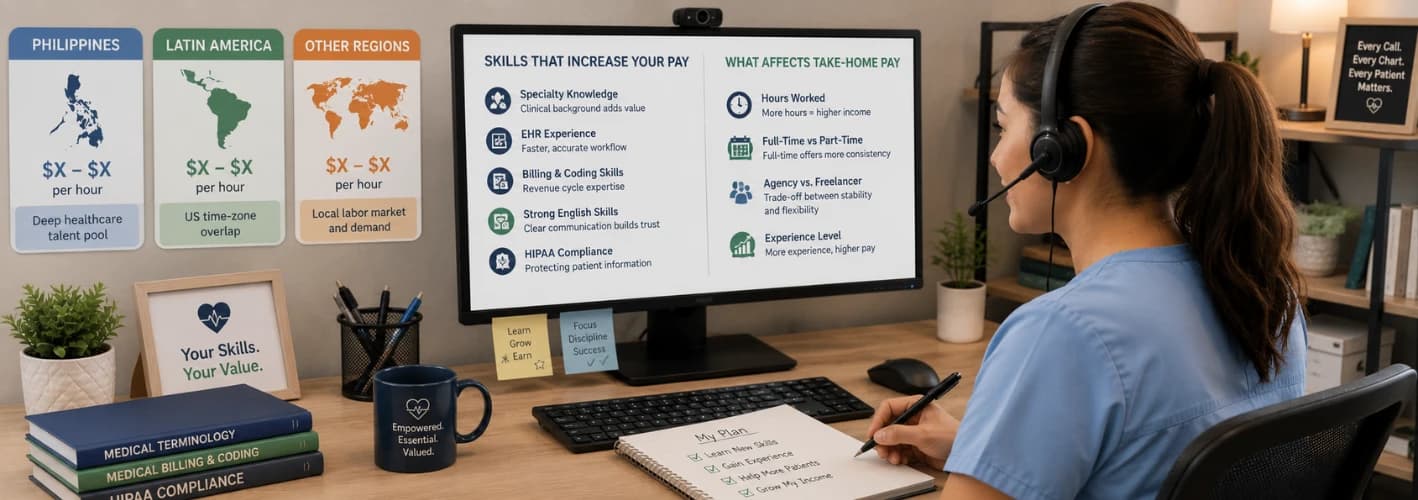
Yes. Local cost of living and local labor markets set different baselines, so the same work pays differently in the Philippines, Latin America, India, and Pakistan. Working remotely for a US practice doesn't erase those local differences.
The Philippines is a long-established hub for healthcare virtual assistants, with a deep pool of nurses and other trained professionals. Latin America has grown as a second hub, valued for time-zone overlap with the US and for bilingual Spanish and English assistants. Each region has its own band, and blending them into one global average is what makes most quoted figures useless.
Cost of living is the main reason the bands differ. A rate that is strong in one country may sit mid-pack in another. Rather than print unsourced ranges, the table below sets out what pushes each region's band up or down, so you can read an offer against your own market.
| Region | What pushes the band up | What holds it down |
|---|---|---|
| Philippines | Deep pool of nurses and other licensed professionals; long track record with US practices | Lower local cost of living; heavy competition for entry-level roles |
| Latin America | US time-zone overlap; bilingual Spanish and English work commands a premium | Smaller healthcare-trained pool than the Philippines |
| India | Large medical billing and coding talent base; certification is common | Limited time-zone overlap with US clinic hours |
| Pakistan | Growing revenue-cycle and coding experience base | Newer market, so fewer practices know it |
For context on the client side rather than take-home pay, Honest Taskers publishes a rate of $10.00 to $12.65 per hour, which is what a US practice pays for the service. That figure covers recruiting, training, support, and the assistant's pay together, so it is not an assistant's wage. The wider healthcare context sits in our guide on what a virtual healthcare assistant is.
Which Skills Raise a Virtual Medical Assistant's Pay?
The skills that raise a virtual medical assistant's pay are specialty clinical knowledge, hands-on EHR experience, medical billing and coding ability, and strong written and spoken English. Each one makes an assistant productive faster, which is what employers pay more to get.
Specialty knowledge matters because an assistant who already understands a cardiology or dental workflow needs less ramp-up. EHR experience matters for the same reason, since fluency in the kind of system a practice runs shortens onboarding. Billing and coding skills sit at the higher end of the range, because revenue-cycle work directly affects how a practice gets paid.
Communication is the skill people underrate. Clear English, a professional phone manner, and reliable written updates separate the assistants who get trusted with patient-facing work. A nurse or pharmacist moving into the role brings clinical credibility that supports the higher bands too. For more on this, our guide on how to become a virtual medical assistant covers how to build these skills.
What Affects a Virtual Medical Assistant's Take-Home Pay?
Take-home pay beyond the hourly rate depends on hours worked, whether the role is full-time or part-time, and whether you work through an agency or as a freelancer. Two assistants on the same hourly rate can take home different amounts once these factors are counted.
Hours are the obvious lever. A full-time schedule of around 40 hours a week builds to more than a part-time 20-hour week at the same rate. Steady full-time work also tends to come with more reliable income than piecing together short projects.
The work arrangement matters too. Agency placement often brings steadier hours, a defined role, and support, while freelancing can pay more per hour but carries the gaps and admin of finding your own clients. Neither path guarantees an income, and this guide gives information rather than tax or legal advice. How any individual's pay is structured is a conversation to have with the specific employer. Which type of work you do also shapes the rate, and the types of virtual medical assistants breakdown sets them side by side.
How Do Virtual Medical Assistants Get Paid?
Virtual medical assistants usually get paid on an hourly or monthly basis through their agency or directly by the client, on a schedule the agreement sets. The exact method and timing belong in the contract, so read that part closely before you start.
With an agency, pay typically arrives on a set cycle for the hours logged, and the agency handles the client billing side. With direct freelance work, the assistant invoices the client and agrees on the payment method and timing themselves. Either way, the rate, the hours, and the pay schedule should be written down before the first shift.
A quick note on a common mix-up. The hourly rate a US practice pays a staffing company is not the same as the assistant's take-home pay. That client rate covers recruiting, training, support, and the assistant's pay together. When you compare offers, look at your own rate and hours, not the price a practice pays for the service.
What the work pays is covered in our guide on how much a virtual medical assistant costs in 2026.
Ask Honest Taskers what a placed virtual medical assistant would cost your practice.