


At a glance
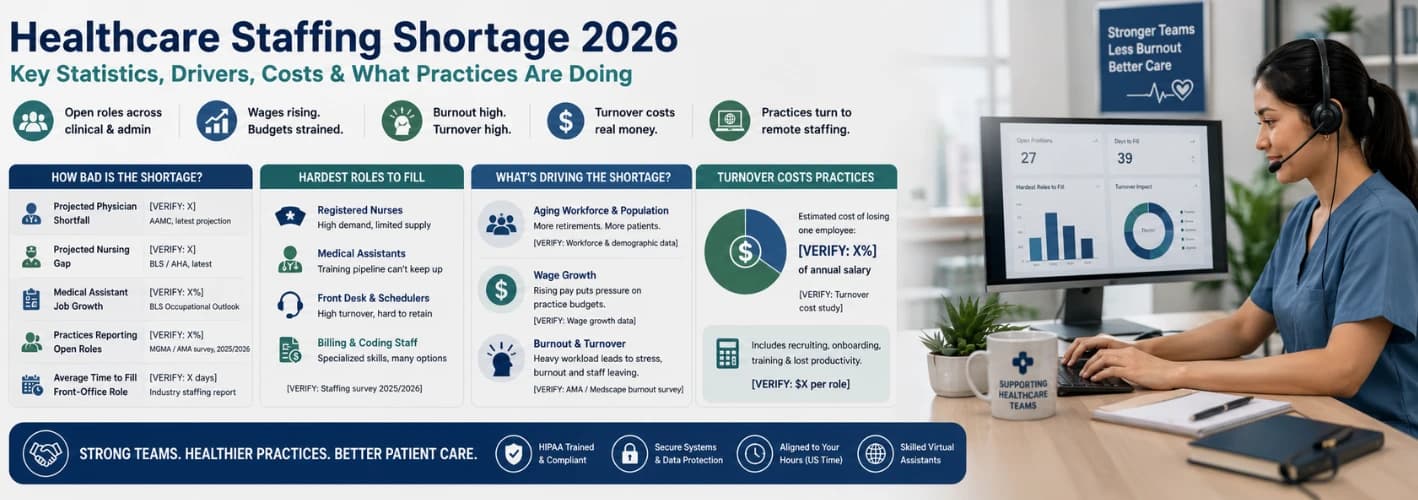
- Projected physician shortfall of up to 86,000 by 2036 (Source: AAMC, 2024).
- Registered nurse jobs up 6% and medical assistant jobs up 13% through 2035 (Source: BLS).
- Receptionist and secretary roles are projected to decline 2%, not grow (Source: BLS).
- Physician burnout is falling, at 41.9% in 2025 from 48.2% in 2023 (Source: AMA).
- Average cost per hire is $5,475 for a non-executive role (Source: SHRM, 2025).
How Bad Is the Healthcare Staffing Shortage in 2026?
The clinical shortage stays severe. The Association of American Medical Colleges projects the US will be short as many as 86,000 physicians by 2036, with a modelled range running from 13,500 at the low end (Source: AAMC, 2024). The range is wide because it depends on how many residency positions get funded, so treat the top number as a ceiling rather than a forecast.
Nursing is tighter than the growth rate alone suggests. BLS projects registered nurse employment to rise 6% between 2025 and 2035, adding about 194,700 jobs against a base of roughly 3.47 million, and the median wage now sits at $97,550 a year (Source: BLS Occupational Outlook Handbook). Growth of 6% counts as faster than the 3% average for all occupations, and it lands on top of a workforce where 20% of clinical physicians are already 65 or older and another 22% are between 55 and 64 (Source: AAMC, 2024).
The administrative picture runs the other way, and this is where most practices get the story wrong. BLS projects medical assistant jobs up 13% and medical records specialist jobs up 8% through 2035, but receptionist and secretary roles down 2%, and medical transcriptionist roles down 4% (Source: BLS Occupational Outlook Handbook). Routine clerical work is being absorbed by software. What practices feel at the front desk is churn and recruiting difficulty, not a shrinking national labor pool.
| Role | Projected change to 2035 | 2025 median pay | Source |
|---|---|---|---|
| Medical assistants | +13%, about 107,600 jobs | $45,690 | BLS OOH |
| Medical records specialists | +8%, about 15,600 jobs | $51,140 | BLS OOH |
| Registered nurses | +6%, about 194,700 jobs | $97,550 | BLS OOH |
| Receptionists | −2%, about 16,000 fewer jobs | $38,010 | BLS OOH |
| Secretaries and administrative assistants | −2%, about 75,300 fewer jobs | $48,310 | BLS OOH |
| Physicians | Shortfall of up to 86,000 by 2036 | Not comparable | AAMC, 2024 |
Which Healthcare Roles Are Hardest to Fill?
Recruiting difficulty is best measured where someone surveys it, and in dentistry the answer is stark: of the 37.6% of dentists who tried to recruit a hygienist in the first quarter of 2026, more than 90% called it "very or extremely challenging" (Source: ADA Health Policy Institute, Q1 2026). Only 60% of dentists report having enough hygienists on staff.
Dental assistants show the same pattern, with 36.7% of practices recruiting for one in that quarter. The pipeline is not the problem: first-year dental hygiene enrollment rose 16% between 2020 and 2025, and 2025 produced the highest number of graduates on record. The difficulty sits in matching candidates to the hours, wages, and benefits practices are advertising.
For medical practices, published survey data on time-to-fill by role is thinner, so this guide will not put a number on it. What the wage data does show is that pay is not the release valve a single practice can pull alone. Total compensation costs across the economy rose 3.4% in the twelve months to June 2026, with wages and salaries up 3.2% (Source: BLS Employment Cost Index). In dentistry specifically, average hourly wages for office staff were flat over twelve months once inflation is accounted for (Source: ADA HPI, Q1 2026), which means raising pay moves a practice up the local queue without adding anyone to the pool.
What Is Driving the Healthcare Staffing Shortage?
Three forces stack: an aging workforce, wage growth that outruns small-practice budgets, and administrative load that pushes clinicians toward burnout. No one of them explains the gap on its own.
The demographic piece is the most measurable. With 20% of clinical physicians at 65 or older and 22% at 55 to 64, roughly two in five are inside a decade of typical retirement age (Source: AAMC, 2024), while the patient population that needs them keeps growing.
Administrative load is the piece a practice can act on. The most-cited time-and-motion study of ambulatory practice found physicians spent 49.2% of the office day on EHR and desk work against 27.0% on direct clinical face time with patients, close to two hours of desk work for every hour with a patient (Source: Sinsky et al., Annals of Internal Medicine, 2016). That study is now ten years old, and the documentation burden it measured has not gone away. The AMA reports family physicians still spend about 86 minutes a night in the EHR after hours.
Burnout deserves an honest note, because the trend runs against the usual telling. Physician burnout is falling, not rising: 41.9% of physicians reported at least one symptom in 2025, down from 43.2% in 2024 and 48.2% in 2023, across nearly 19,000 responses (Source: AMA Organizational Biopsy). It remains high in absolute terms, and it varies sharply by specialty, from 49.8% in emergency medicine to the low forties in cardiology and gastroenterology.
How Much Does Staffing Turnover Cost a Medical Practice?
The average cost per hire for a non-executive role is $5,475 (Source: SHRM 2025 Benchmarking Report), and the fuller replacement cost is usually quoted as six to nine months of that role's salary by SHRM, or 50% to 200% of annual salary by Gallup depending on seniority. Quote whichever range you use with its owner attached, because the three numbers measure different things.
Cost per hire counts recruiting: advertising, screening, interviewing, recruiter and hiring-manager time. The wider replacement estimates add the weeks a new hire takes to reach full productivity, plus what the empty seat costs while it sits. For a front-desk or billing role, that second part is the one owners underestimate, because unanswered calls and unworked claims show up in revenue rather than on the turnover line.
It is also where denials compound. In Experian Health's 2025 State of Claims survey of 250 healthcare professionals, 41% of providers reported denial rates of 10% or higher, and 68% said submitting clean claims had become harder than a year earlier. A vacant or newly trained billing seat makes that worse. Our guide on what a virtual medical assistant costs lays out the hourly side of the comparison.
What Are Practices Doing About Staffing Gaps?
Practices are combining higher pay, software that removes manual steps, cross-training, and remote staffing that adds coverage without another local salary. Most owners run several of these at once, because no single move closes the gap.
Raising pay works locally but does not add people to the pool, and the flat real-wage data from dentistry shows how quickly the whole market moves together. Automating reminders and intake trims genuine manual work, and it is part of why BLS projects clerical roles to shrink. Cross-training spreads coverage but concentrates risk on the people who stay, which is the group you least want to lose.
Remote staffing has grown as a fourth option, mostly for the front-office and billing work that is hardest to keep filled locally. A virtual medical assistant works in the practice's own systems, on hours the practice sets, across all US time zones. The framing is augmentation rather than replacement: the remote assistant absorbs administrative load so the on-site team can spend its time on the people in the building, and so clinicians spend less of the day in the EHR. See what a virtual healthcare assistant is for the role itself, the tasks one can take over, and how to hire one.