


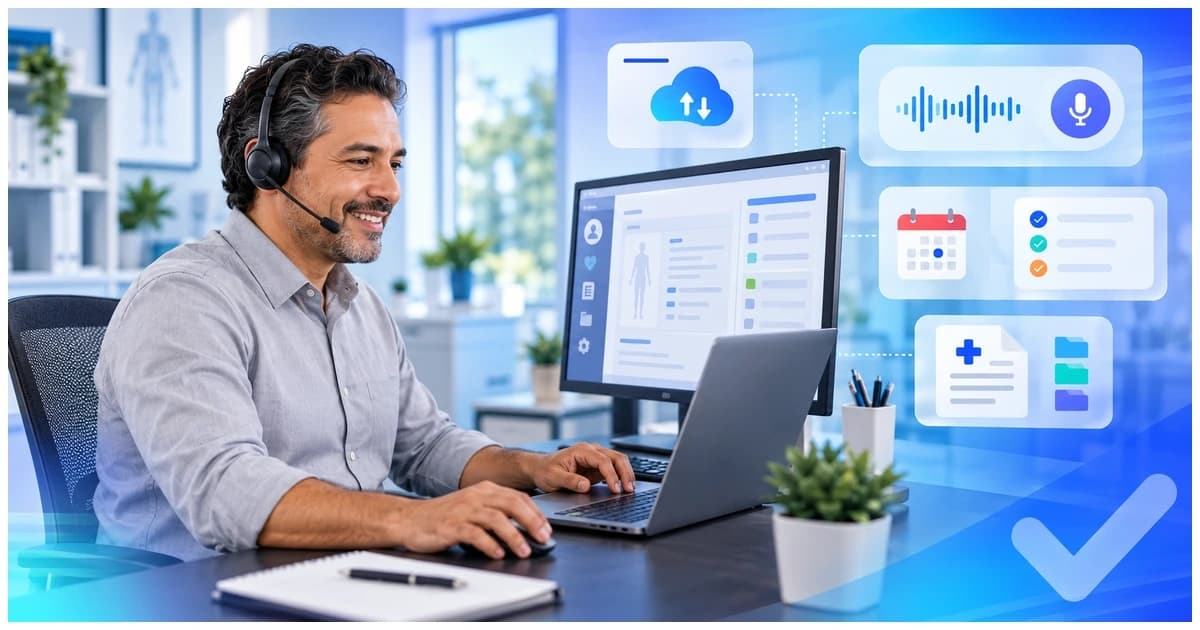
This guide covers the tools a virtual medical scribe uses, which EHR or EMR the scribe works in, the dictation and template tools involved, how scribes communicate securely with the practice, the scheduling and productivity software used, whether scribes use AI scribe tools, and how a practice matches a scribe to its software stack.
The exact products depend on the practice. Experience varies by the systems a scribe has supported, so Honest Taskers matches each scribe to the practice's technology stack rather than promising experience in a specific product.
At a glance
- The EHR or EMR is the center of the job, where the scribe writes and structures the note.
- Dictation and template tools help the scribe speed up repeat documentation and capture provider input.
- Secure messaging keeps scribe-to-team communication inside HIPAA-aware channels.
- Scheduling software lets the scribe see the visit flow and prep charts ahead.
- AI scribe tools can help, but output still needs human and provider review for accuracy.
What Tools Does a Virtual Medical Scribe Use?
A virtual medical scribe uses the practice's EHR as the core tool, supported by dictation and template tools, secure messaging, scheduling software, and everyday productivity apps. The stack varies by practice, but the categories stay consistent across placements.
Most of the day runs in the EHR, where the scribe builds the clinical note. The other tools support that work. Dictation and templates speed up documentation, secure messaging handles communication, scheduling shows the day ahead, and productivity tools keep tasks organized. The table below groups the categories with example products.
| Category | What it does for the scribe | Example products |
|---|---|---|
| EHR / EMR | Where the clinical note is written and stored | Epic, athenahealth, eClinicalWorks, Dentrix |
| Dictation and templates | Captures provider input and speeds repeat documentation | Practice-provided dictation tools, EHR note templates and macros |
| Secure messaging | HIPAA-aware communication with the care team | Practice-approved secure messaging platforms |
| Scheduling | Shows the visit flow so the scribe can prep charts ahead | EHR scheduling modules, practice-management calendars |
| Productivity | Task tracking, secure file handling, and shift handoffs | Practice-approved task and document tools |
One point holds across every category. The scribe uses the practice's own approved tools, not a separate personal setup. That keeps patient data inside systems the practice controls. The full role overview sits in our virtual medical scribe guide.
Sinsky and colleagues, in "Allocation of Physician Time in Ambulatory Practice", a 2016 time and motion study in Annals of Internal Medicine, observed physicians spending 49.2% of the office day on EHR and desk work against 27.0% on direct clinical face time.
Which EHR or EMR Does a Virtual Medical Scribe Work In?
A virtual medical scribe works in whichever EHR or EMR the practice already uses, because the scribe writes notes inside the practice's own system through a secure account. The EHR is the single most important tool, since the clinical note is the product the scribe delivers.
EHR systems are real products, like Epic, athenahealth, eClinicalWorks, and Dentrix on the dental side. A scribe may work in any of them. Honest Taskers doesn't guarantee experience in a specific system, because that experience varies by the practices a candidate has supported. Instead, the company matches each scribe to the practice's stack and fills any gap with onboarding.
General EHR fluency matters more than any one product. A scribe who understands note structure, order entry, and chart navigation picks up a new system in days. That's why matching beats assuming, and why a practice's specific EHR isn't a barrier. For more on this, our guide on virtual medical scribe skills covers EHR fluency in more depth.
What Dictation and Template Tools Do Scribes Use?
Scribes use dictation tools to capture spoken provider input and note templates to speed up the repeat parts of documentation, both inside or alongside the practice's EHR. These tools cut the time spent retyping standard content, so the scribe can focus on the parts of each note that are unique.
Templates do a lot of the lifting. Most EHRs let a practice build note templates and text macros for common visit types, so a routine follow-up starts from a structured shell instead of a blank page. The scribe fills in the specifics, and the standard sections are already in place. That's where same-day note closure often comes from.
Dictation supports the asynchronous side of the work. A provider may record a visit or dictate notes for the scribe to draft afterward. The scribe turns that audio into a structured note, then routes it back for review. Whatever the tool, the provider reviews and signs the final note. The drafting speeds the work, but the clinical responsibility stays with the provider.
How Do Scribes Communicate Securely With the Practice?
Scribes communicate with the practice through secure, HIPAA-aware messaging the practice approves, never through personal email or consumer chat apps for anything touching patient data. Secure messaging is how a remote scribe stays part of the team without putting patient information at risk.
The day involves real back-and-forth. The scribe flags a gap in a note, asks the provider to clarify a plan, or hands off pending items at shift end. All of that runs through channels the practice controls, so the communication trail stays inside approved systems. A scribe keeps clinical questions in the secure channel, not in a side conversation.
This ties back to HIPAA habits. Every Honest Taskers scribe completes documented HIPAA training before placement and signs a confidentiality agreement, then works under practice-specific access controls. Keeping communication in approved tools is part of that discipline. Compliance lives in the practice's own policies, so the practice sets the channels and the scribe works inside them. Which certification is worth holding is covered in our guide on medical scribe training and certification.
What Scheduling and Productivity Software Do Scribes Use?
Scribes use the practice's scheduling software to see the day's visit flow and prep charts ahead, plus productivity tools for task tracking, secure file handling, and shift handoffs. These tools keep the scribe organized so notes don't pile up and nothing slips between shifts.
Scheduling visibility helps the scribe stay ahead. Seeing the upcoming visits lets the scribe prep charts, pull prior notes, and line up templates before each encounter starts. For a real-time scribe, that prep is the difference between keeping pace and falling behind during a busy clinic block.
Productivity tools handle the rest. A scribe tracks pending notes, manages a task list of follow-ups for the provider, and writes a clean shift handoff so the next person knows what's open. These are usually the practice's own approved tools. A scribe who supports a broader admin load may use more of them, which our guide to virtual medical assistant tools and software covers.
Do Virtual Medical Scribes Use AI Scribe Tools?
Some practices use AI scribe tools, and a virtual medical scribe can work alongside them, but the output always needs human and provider review for accuracy and has to meet the practice's HIPAA requirements. AI drafting can speed a note, yet it doesn't remove the need for a trained person to check it.
AI scribe tools generate a draft note from the visit audio. That draft can save time, but it can also miss context, mishear terms, or structure the note in ways the provider doesn't want. A trained scribe reviews the draft, corrects errors, and shapes it to the provider's preferences. The human catch is the point, not an extra step.
Two cautions hold. First, accuracy stays the provider's responsibility, and the provider reviews and signs every note regardless of how it was drafted. Second, any tool touching patient data has to meet the practice's HIPAA requirements, which the practice decides, not the staffing company. A scribe uses only the tools the practice has approved for patient data. The role itself is defined in our guide on what a medical scribe is.
How Does a Practice Match a Scribe to Its Software Stack?
A practice matches a scribe to its software stack by sharing its EHR and tool list with the staffing company, which selects a candidate whose experience fits and fills any gap during onboarding. The match starts before placement and finishes in the first weeks on the job.
The process is simple. The practice names its EHR, its messaging and scheduling tools, and any specialty software. Honest Taskers matches a healthcare-trained scribe whose background fits that stack, or whose general fluency makes the system quick to learn. Onboarding then covers the practice's specific templates, access, and preferences.
A two-week working trial on the first hire lets the practice watch the fit on real visits before committing. Coverage runs full time at 40 hours per week or part time at 20, across all US time zones, aligned to clinic hours, and most placements complete within 1 to 3 weeks of agreement signing. Our guide on how to hire a medical scribe walks through scoping the stack and running the trial.
Published by Honest Taskers, a healthcare staffing company headquartered in Fort Worth, Texas, founded by Roland Omene. Honest Taskers places healthcare-trained virtual scribes and assistants with US medical, dental, and mental health practices.
What the work pays is covered in our guide on what a virtual medical scribe earns.
Ask Honest Taskers for a medical scribe who works inside your own stack.